

FLASH Research : Mental health in Cycle 5 : contribution of work, non-work and individual factors
The fifth cycle of the Longitudinal Study of the Observatory on Health and Well-Being at Work (ELOSMET) involved 86 Canadian workplaces. Their employees were surveyed between October 3, 2023, and April 21, 2025. A total of 1,466 employees aged 18 and over agreed to complete the online questionnaire, yielding a response rate of 50.5%. This FLASH Research presents preliminary findings on the contribution of work, non-work and individual factors to two mental health indicators: psychological distress and burnout. 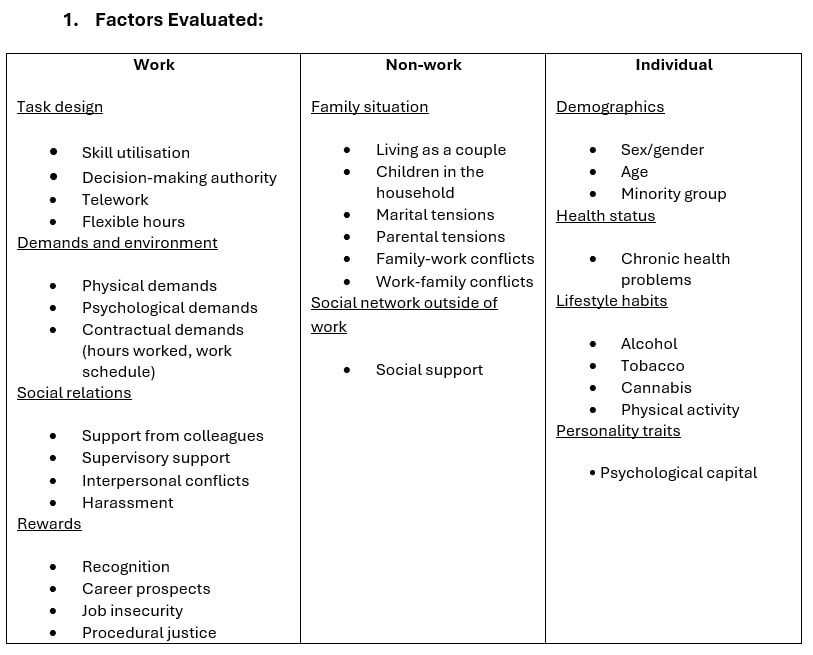
-
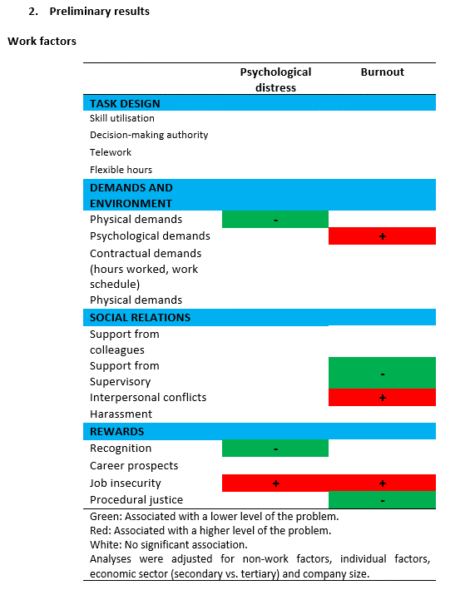
- Psychological distress :
- Lower when physical demands and recognition are high.
- Higher when job insecurity is high.
- Psychological distress :
- Burnout :
- Lower when supervisor support and procedural justice are high.
- Higher when psychological demands, interpersonal conflicts and job insecurity are high.
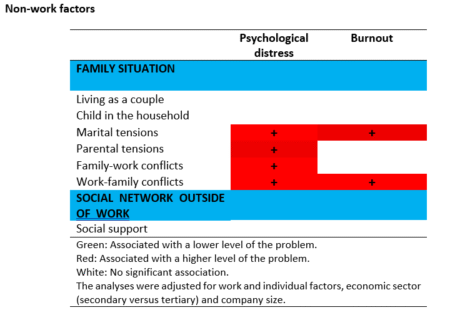
- Psychological distress:
- Higher when there are high levels of marital and parental tension, and family-work/work-family conflict.
- Burnout :
- Higher when marital and work-family tensions are high.
- Psychological distress and burnout have marital tensions and work-family conflicts in common.
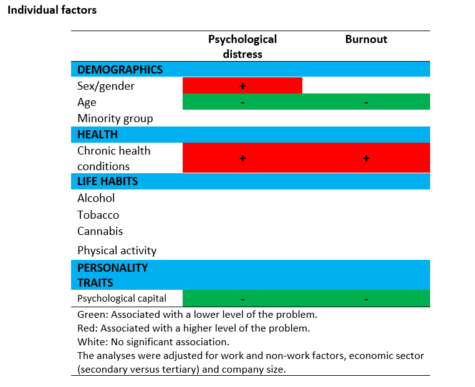
- Psychological distress:
- Lower when the person is older and has high psychological capital.
- Higher for women and in cases of chronic health problems.
- Burnout :
- Lower when the person is older and has high psychological capital.
- Higher in cases of chronic health problems.
- Psychological distress and burnout have three things in common: age of the person, chronic health problems and psychological capital.
Conclusion
Overall, these preliminary Cycle 5 results support the observations made in previous Flash Research reports¹-⁴. The non-work situation appears to play a more significant role in cases of psychological distress, whereas burnout appears to be more strongly influenced by organizational working conditions. Individual factors remain essentially the same across all indicators. Although these results are preliminary, they allow us to draw the following conclusions:
- In the workplace, having more physical demands, counting on the support of supervision, being recognised for the work accomplished and working in an organisation whose practices and procedures are based on principles of justice, appear to be favourable factors in protecting the mental health of individuals. However, psychological demands such as workload, work pace, conflicting demands, interpersonal conflicts, as well as job insecurity are associated with higher mental health symptoms.
- Outside the workplace, the greater the tension with the spouse and children, and the greater the difficulties in balancing the demands of work and family, the more fragile mental health appears to be. Work-family conflicts appear to be the only significant factor in burnout.
- In terms of individual characteristics, being older and having greater psychological capital — that is, a personality marked by self-efficacy, hope, resilience and optimism — appears to lead to a lower perception of mental health symptoms. However, being a woman and having a state of health weakened by one or more chronic health problems will tend to result in more symptoms of mental health problems.
- As previously suggested in Research Flashes, implementing an integrated approach to prevention that promotes management practices for controlling working conditions, work-life balance and personal health can yield positive results in reducing mental health issues and absenteeism5-6.
References
- Observatoire sur la santé et le mieux-être au travail (Octobre, 2021). Psychological distress and burnout: Contribution of work, non-work, and individual factors. FLASH Research Collection, Université de Montréal. https://www.osmet.umontreal.ca/flash-recherche-detresse-psychologique-et-epuisement-professionnel-contribution-des-facteurs-du-travail-hors-travail-et-individuels/
- Observatoire sur la santé et le mieux-être au travail (July 2024). Mental health in Cycle 4: Contribution of work, non-work and individual factors. FLASH Research Collection, Université de Montréal. https://www.osmet.umontreal.ca/flash-recherche-la-sante-mentale-au-cycle-4-contribution-des-facteurs-du-travail-hors-travail-et-individuels/
- Observatoire sur la santé et le mieux-être au travail (December, 2023). Mental health in Cycle 3: Contribution of work, non-work, and individual factors. FLASH Research Collection, Université de Montréal. https://www.osmet.umontreal.ca/flash-recherche-la-sante-mentale-au-cycle-3-contribution-des-facteurs-du-travail-hors-travail-et-individuels/
- Observatoire sur la santé et le mieux-être au travail (October, 2022). Mental health in Cycle 2 of ELOSMET study. October 2022. https://www.osmet.umontreal.ca/flash-recherche-la-sante-mentale-au-cycle-2-de-lelosmet/
- Marchand, A., Haines, V. Y., Harvey, S., Dextras‐Gauthier, J., and Durand, P. (2016) Health and Stress Management and Mental‐health Disability Claims. Stress & Health, 32: 569–577. doi: 1002/smi.2663.
- Observatoire sur la santé et le mieux-être au travail (October, 2020). Absenteeism and workplace health and wellness management practices. FLASH Research Collection, Université de Montréal.
https://www.osmet.umontreal.ca/publications/flash-recherche/flash-recherche-labsenteisme-et-les-pratiques-de-gestion-en-sante-et-mieux-etre-au-travail/
Website: www.osmet.umontreal.ca
About OSMET
The Observatoire sur la santé et le mieux-être au travail (OSMET) was born of a collaboration between the Faculty of Arts and Sciences, the Institut de recherche en santé publique (now the Centre de recherche en santé publique) and the School of Industrial Relations of the Université de Montréal. OSMET receives financial support from four founding partners: TELUS Health (formerly Morneau Shepell, then LifeWorks Wellness Solutions), McKesson Canada, Medavie Blue Cross and Pratt & Whitney Canada.
The OSMET Flash Research Collection
- Changes in mental health indicators over the five cycles of ELOSMET. June 2025. https://www.osmet.umontreal.ca/en/flash-recherche-evolution-des-indicateurs-de-sante-mentale-aux-cinq-cycles-de-lelosmet/
- How is the mental health of managers? December 2024. https://www.osmet.umontreal.ca/en/flash-recherche-comment-ca-va-la-sante-mentale-des-cadres/
- Evolution of mental health indicators in the first three cycles of ELOSMET study. July 2023. https://www.osmet.umontreal.ca/flash-recherche-levolution-des-indicateurs-de-sante-mentale-dans-les-trois-premiers-cycles-de-lelosmet/
- Mental health in Cycle 4: Contribution of work, non-work and individual factors. July 2024. https://www.osmet.umontreal.ca/en/flash-recherche-la-sante-mentale-au-cycle-4-contribution-des-facteurs-du-travail-hors-travail-et-individuels/
- Mental health in Cycle 3: Contribution of work, non-work, and individual factors. December, 2023. https://www.osmet.umontreal.ca/flash-recherche-la-sante-mentale-au-cycle-3-contribution-des-facteurs-du-travail-hors-travail-et-individuels/
- Evolution of mental health indicators in the first three cycles of ELOSMET study. July 2023. https://www.osmet.umontreal.ca/en/flash-recherche-levolution-des-indicateurs-de-sante-mentale-dans-les-trois-premiers-cycles-de-lelosmet/
- Prevalence of mental health problems in the workplace during COVID-19: ELOSMET Cycle 2 results. November 2022. https://www.osmet.umontreal.ca/flash-recherche-prevalence-des-problemes-de-sante-mentale-en-milieux-de-travail-pendant-la-covid-19-les-resultats-du-cycle-2-de-lelosmet/
- Mental Health in Cycle 2 of ELOSMET study. October 2022. https://www.osmet.umontreal.ca/flash-recherche-la-sante-mentale-au-cycle-2-de-lelosmet/
- The best practices for intervening and reducing mental health problems in the workplace. May 2022. https://www.osmet.umontreal.ca/publications/flash-recherche/flash-recherche-les-meilleures-pratiques-pour-intervenir-et-diminuer-les-problemes-de-sante-mentale-au-travail/
- Psychological distress and burnout: Contribution of work, non-work, and individual factors. October 2021. https://www.osmet.umontreal.ca/flash-recherche-detresse-psychologique-et-epuisement-professionnel-contribution-des-facteurs-du-travail-hors-travail-et-individuels/
- Portrait of the implementation of occupational health and wellness management practices. June 2021. https://www.osmet.umontreal.ca/publications/flash-recherche/flash-recherche-les-pratiques-de-gestion-de-la-sante-et-du-mieux-etre-au-travail/
- Mental health in the workplace during a pandemic: Early results from ELOSMET Cycle-1. January 2021. https://www.osmet.umontreal.ca/publications/flash-recherche/flash-recherche-la-sante-mentale-en-milieux-de-travail-en-temps-de-pandemie/
- Absenteeism and workplace health and wellness management practices. October 2020. https://www.osmet.umontreal.ca/publications/flash-recherche/flash-recherche-labsenteisme-et-les-pratiques-de-gestion-en-sante-et-mieux-etre-au-travail/
- Telework, working conditions and work-family conflicts. June 2020. https://www.osmet.umontreal.ca/publications/flash-recherche/flash-recherche-teletravail-conditions-de-travail-et-conflits-travail-famille/
This content has been updated on 14 November 2025 at 16h23.