

FLASH Research : Evolution of mental health indicators in the first four cycles of ELOSMET
This FLASH Research presents the preliminary results of the evolution of mental health symptoms among the 7,008 people from 95 workplaces who participated in the Longitudinal Study of the Observatory on Health and Well-being at Work (ELOSMET). This online survey started in 2019 and has been repeated every year for five years. It addresses several dimensions of health and well-being at work, as well as a set of working conditions, non-work life situations and personal characteristics.
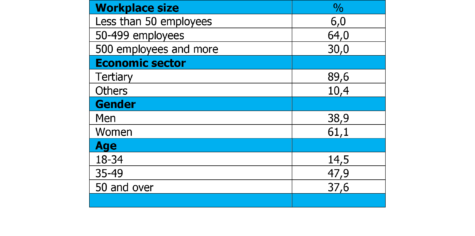
Cycle-1 data collection covers the period 2019-2021 (n=3025), cycle-2 2020-2022 (n=3495), cycle-3 2021-2023 (n=2946) and cycle-4 2022-2024 (n=1785). The response rate varied between 37% and 63% depending on the cycle. The following table presents the main socio-demographic and workplace characteristics of this sample.
The following questionnaires were used:
· Psychological distress: Minor psychiatric disorders (depressive symptoms, anxiety, irritability, cognitive problems) not specific to a particular illness. Score of 4 and above on the General Health Questionnaire (GHQ-12).1
· Depression (measured from cycle-2): Scores of 10 and above (moderate and more severe symptoms) on the Patient Health Questionnaire (PHQ-9).2
· Anxiety (measured from cycle-2): Score of 10 and above (moderate and more severe symptoms) on the General Anxiety Disorder (GAD-7).3
· Professional burnout: Fatigue, physical and psychological exhaustion perceived by the person as being linked to their work. Score of 50 and above (moderate symptoms and above) on the Copenhagen Burnout Inventory (CBI-7).4
· Psychotropic drugs use: Consumption of the past month of at least one medication such as tranquilizers (e.g.: diazepam, Valium), antidepressants (e.g.: fluoxetine, Prozac), opiates (e.g.: codeine, Ratio-lenoltec #3), or sleeping pills (e.g. zopiclone, Imovane).
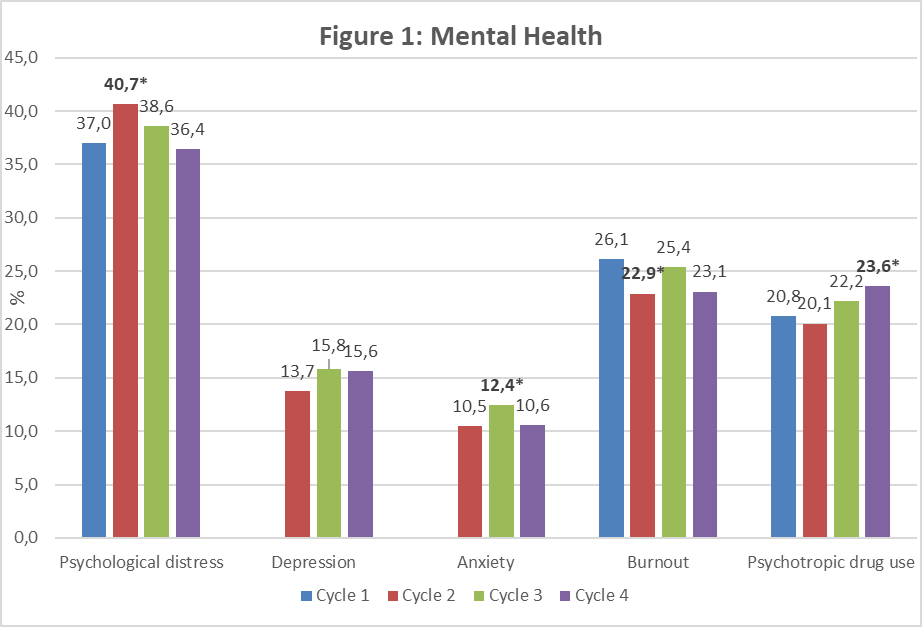
Figure 1 shows the general evolution of the five mental health indicators.
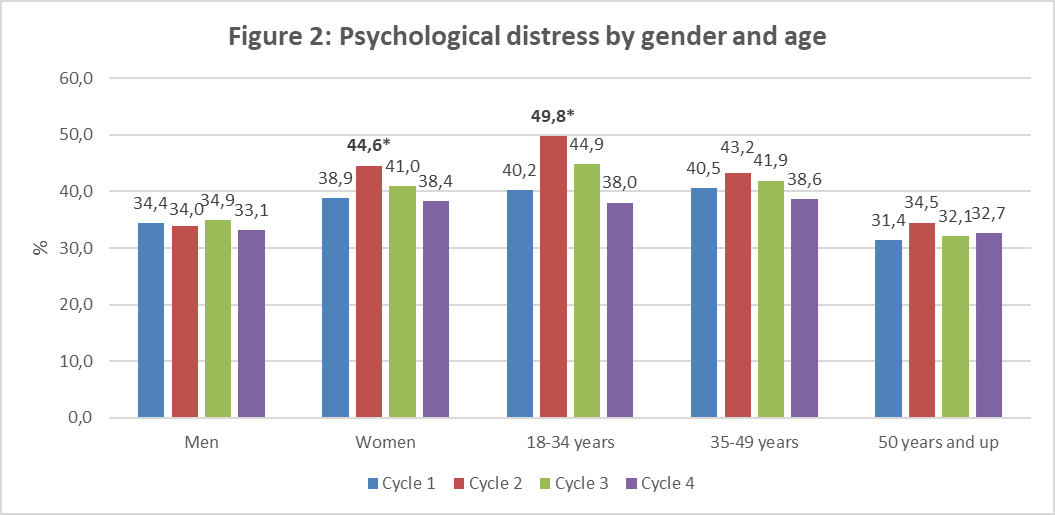
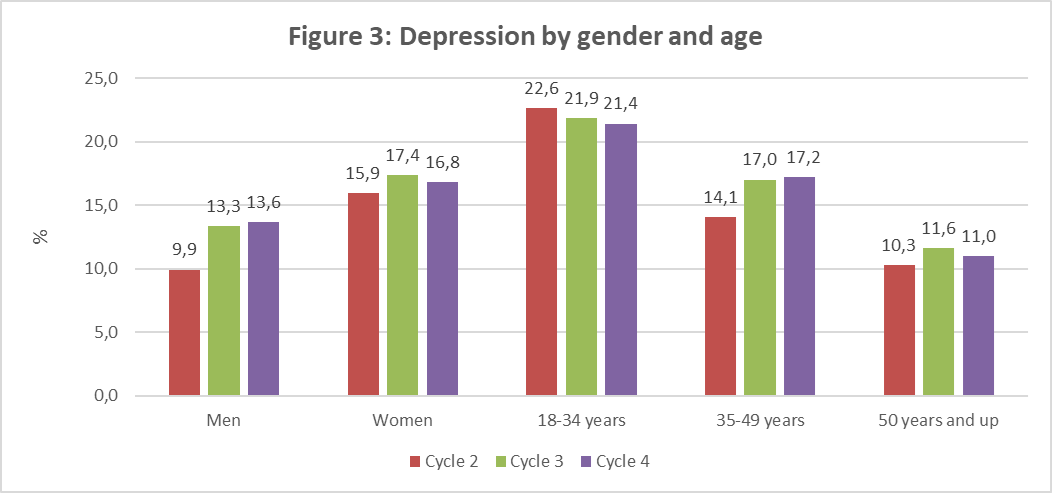
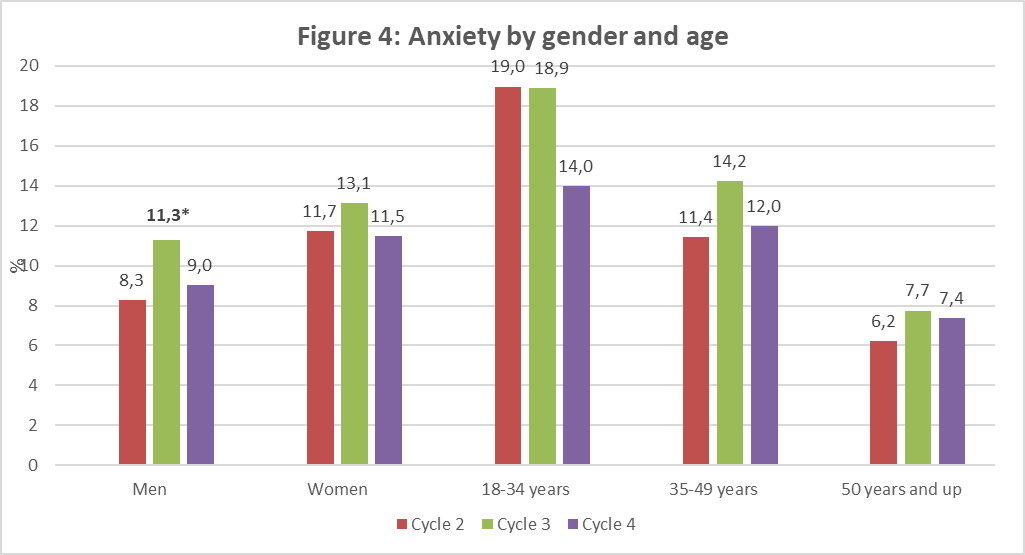
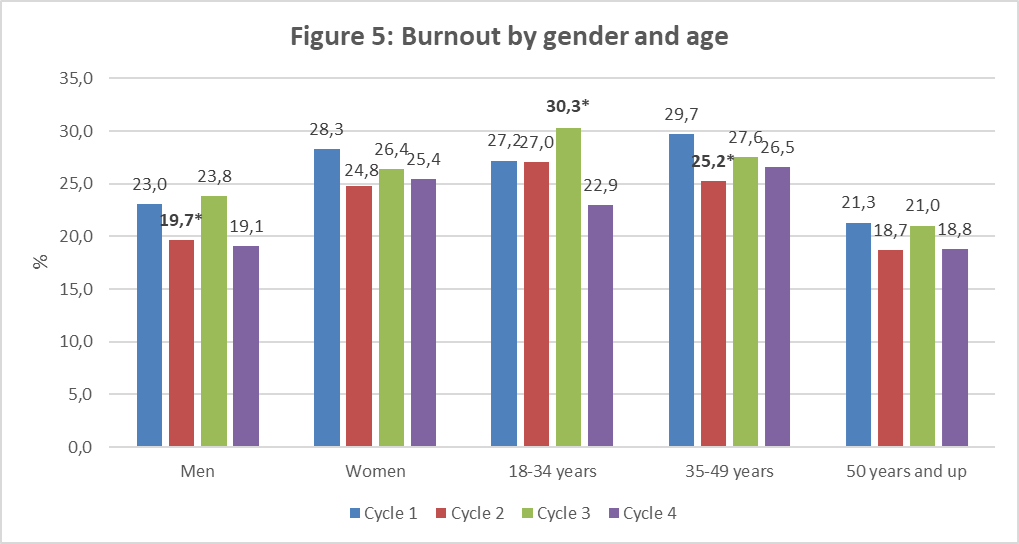
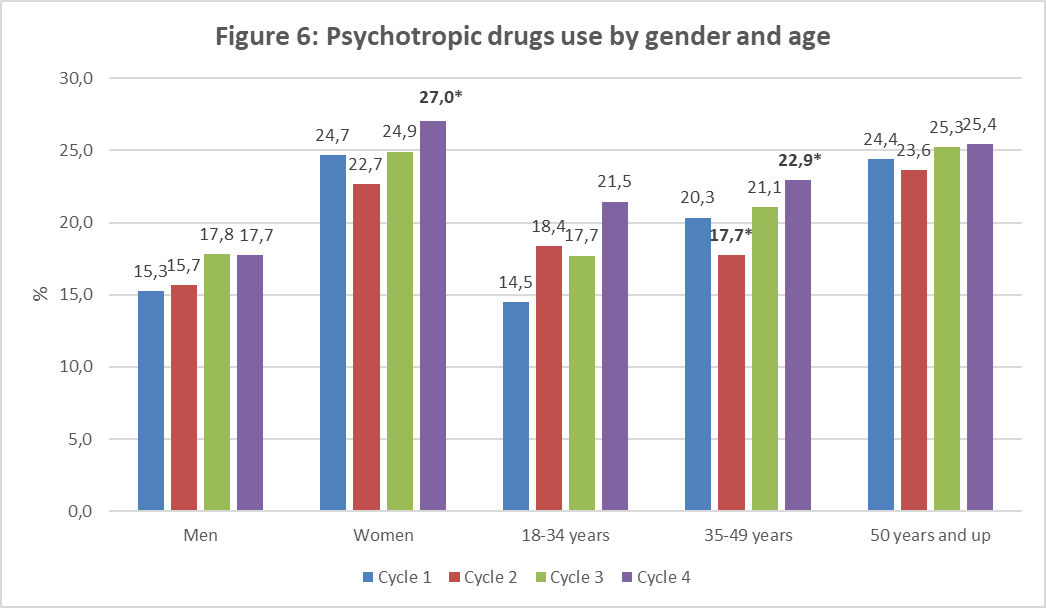
Figures 2 to 6 present the evolution of mental health indicators according to gender and age.
The findings are as follows:
- Globally,
- Psychological distress increased between cycle-1 and cycle-2, but, from cycle-3, it returns to a level observed in cycle-1;
- The prevalence of anxiety increased in cycle-3, then reaching in cycle-4 the level observed for cycle-1;
- Burnout decreased between cycle-1 and cycle-2, but returned to its initial level for cycle-3 and cycle-4;
- The prevalence of psychotropic drugs use increased between cycle 1 and cycle 4.
- For differences by gender and age,
- Distress increased between cycle-1 and cycle-2 among women and 18-34-year-olds, but it returns to the initial level from cycle-3;
- Anxiety increased in cycle 3 among men, but in cycle 4, it returned to the level observed for cycle 1;
- Burnout decreased in cycle-2 compared to cycle-1 among men as well as among 35–49-year-olds, but it returns to its initial level from cycle-3. Also, the symptoms increased significantly in cycle-3 among 18-34-year-olds compared to cycle-1 but at cycle-4, they return to the level observed for cycle-1;
- Psychotropic drugs use decreased in cycle 2 among 35-49-year-olds. However, this psychotropic drugs use increased among women and 35-49-year-olds in cycle 4 compared to cycle 1.
Conclusion
ELOSMET has already documented that mental health problems among employed people are significant and vary according to gender and age. Arriving at cycle-4, and for all respondents, psychological distress affects 36.4% of people, 10.6%-15.6% report symptoms of anxiety or depression, 23.1% of burnout and 23.6% use psychotropic drugs. The situation of women and younger people remains worrying.
When we examine the evolution of these conditions over time, psychological distress has been influenced by the COVID-19 pandemic. However, burnout has decreased during the pandemic. This drop is possibly linked to changes in the organization of work and access to teleworking. However, ELOSMET data suggest that these variations were occasional, because the indicators returned to pre-pandemic levels in cycle-4, except for the psychotropic drugs use. The effects associated with confinement, the fear of contamination and the obligation to telework for many people seem to be diluted over time with the control of contamination and the return to work in face-to-face or hybrid mode.
It could be that the increased of psychotropic drugs use in cycle-4 is the result of developments in mental health problems during and after the pandemic, particularly for 35-49-year-olds and women. Analyzes will be necessary to explain these variations, but it is possible to consider greater difficulty for 35-49-year-olds and women in returning to a work situation which involves constraints and demands linked to travel to get to work, and consequently a return to greater difficulties in balancing work, family and personal life.
The results presented here will be updated periodically.
References
- McDowell, I. & Newell, C. (1996) Measuring health: a guide to rating scales and questionnaires, 2nd edn. Oxford University Press, New York
- Kroenke, K., Spitzer, R. L. & Williams, J. B. W. (2001). The PHQ-9: Validity of a brief depression severity measure. J Gen Intern Med, 16(9), 606-613.
- Spitzer, R. L., Kroenke, K., Williams, J. B. W. & Löwe, B. (2006). A brief measure for assessing generalized anxiety disorder: The GAD-7. Archives of Internal Medicine, 166(10), 1092-1097.
- Kristensen, T.S., Borritz, M., Villadsen, E. & Christensen, K.B. (2005) The Copenhagen Burnout Inventory: A new tool for the assessment of burnout, Work & Stress, 19(3), 192-207.
Website: https://www.osmet.umontreal.ca/en
About OSMET
The Observatory on Health and Well-being at Work (OSMET) was born from a collaboration with the Faculty of Arts and Sciences, the Public Health Research Institute (now the Public Health Research Center) and the School of Industrial Relations of the University of Montreal. OSMET benefits from the financial support of three founding partners: TELUS health, Medavie and Pratt & Whitney Canada.
The OSMET FLASH Research collection
- Telework, working conditions and work-family conflicts. June 2020. https://www.osmet.umontreal.ca/publications/flash-recherche/flash-recherche-teletravail-conditions-de-travail-et-conflits-travail-famille/
- Absenteeism and workplace health and wellness management practices. October 2020. https://www.osmet.umontreal.ca/publications/flash-recherche/flash-recherche-labsenteisme-et-les-pratiques-de-gestion-en-sante-et-mieux-etre-au-travail/
- Mental health in the workplace during a pandemic: Early results from ELOSMET Cycle-1. January 2021. https://www.osmet.umontreal.ca/publications/flash-recherche/flash-recherche-la-sante-mentale-en-milieux-de-travail-en-temps-de-pandemie/
- Portrait of the implementation of occupational health and wellness management practices. June 2021. https://www.osmet.umontreal.ca/publications/flash-recherche/flash-recherche-les-pratiques-de-gestion-de-la-sante-et-du-mieux-etre-au-travail/
- Psychological distress and burnout: Contribution of work, non-work, and individual factors. October 2021. https://www.osmet.umontreal.ca/flash-recherche-detresse-psychologique-et-epuisement-professionnel-contribution-des-facteurs-du-travail-hors-travail-et-individuels/
- The best practices for intervening and reducing mental health problems in the workplace. May 2022. https://www.osmet.umontreal.ca/publications/flash-recherche/flash-recherche-les-meilleures-pratiques-pour-intervenir-et-diminuer-les-problemes-de-sante-mentale-au-travail/
- Mental Health in Cycle 2 of ELOSMET study. October 2022. https://www.osmet.umontreal.ca/flash-recherche-la-sante-mentale-au-cycle-2-de-lelosmet/
- Prevalence of mental health problems in the workplace during COVID-19: ELOSMET Cycle 2 results. November 2022. https://www.osmet.umontreal.ca/flash-recherche-prevalence-des-problemes-de-sante-mentale-en-milieux-de-travail-pendant-la-covid-19-les-resultats-du-cycle-2-de-lelosmet/
- Evolution of mental health indicators in the first three cycles of ELOSMET study. July 2023. https://www.osmet.umontreal.ca/flash-recherche-levolution-des-indicateurs-de-sante-mentale-dans-les-trois-premiers-cycles-de-lelosmet/
- Mental health in Cycle 3: Contribution of work, non-work, and individual factors. December, 2023. https://www.osmet.umontreal.ca/flash-recherche-la-sante-mentale-au-cycle-3-contribution-des-facteurs-du-travail-hors-travail-et-individuels/
- Mental health in Cycle 4: Contribution of work, non-work and individual factors. July 2024. https://osmet.openum.ca/en/flash-recherche-la-sante-mentale-au-cycle-4-contribution-des-facteurs-du-travail-hors-travail-et-individuels/
This content has been updated on 4 October 2024 at 18h15.