

Research FLASH : Changes in mental health indicators over the five cycles of ELOSMET
This Research FLASH presents the preliminary results of changes in mental health symptoms among the 7560 people in 117 workplaces who took part in the Longitudinal Study of the Observatory on Health and Wellbeing at Work (ELOSMET). This online survey began in 2019 and is repeated every year for six years. It covers several dimensions of health and well-being at work, as well as a range of working conditions, life situations outside work and personal characteristics.
Data collection for cycle-1 covered the period 2019-2021 (n=3025), cycle-2 2020-2022 (n=3495), cycle-3 2021-2023 (n=2946), cycle-4 2022-2024 (n=1785) and cycle-5 2023-2025 (n=1466). The response rate varied between 37% and 63% depending on the cycle. The following table presents the main sociodemographic and workplace characteristics of this sample.
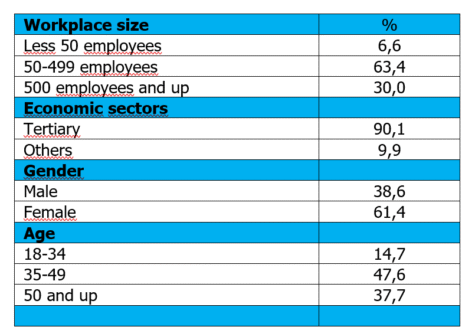
The following questionnaires were used:
- Psychological distress: Minor psychiatric disorders (depressive symptoms, anxiety, irritability, cognitive problems) not specific to a particular illness. Score of 4 or more on the General Health Questionnaire (GHQ-12).1
- Burnout: Fatigue, physical and psychological exhaustion perceived by the person as being work-related. Score of 50 or more (moderate symptoms and more) on the Copenhagen Burnout Inventory (CBI).2
- Consumption of psychotropic drugs: Consumption in the last month of at least one tranquilliser (e.g. diazepam, Valium), antidepressant (e.g. fluoxetine, Prozac), opiate (e.g. codeine, Ratio Lenoltec #3) or sleeping pill (e.g. zopiclone, Imovane).
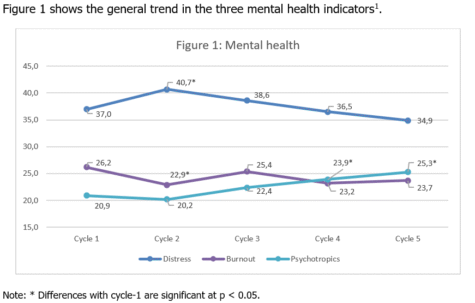
[1] Cycles 2 to 4 assessed depressive and anxiety symptoms, the results of which were presented in a previous Research Flash. : FLASH Research : Evolution of mental health indicators in the first four cycles of ELOSMET | Observatoire sur la santé et le mieux-être au travail
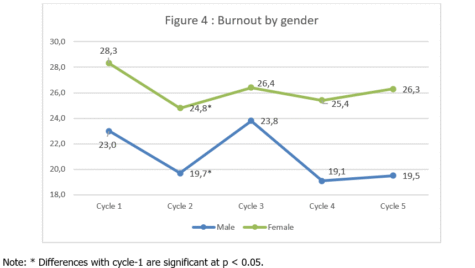
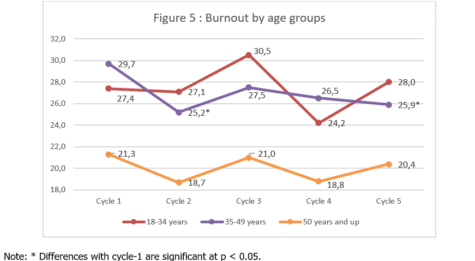
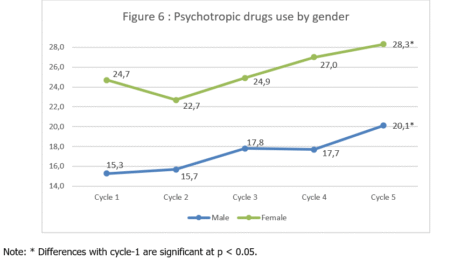
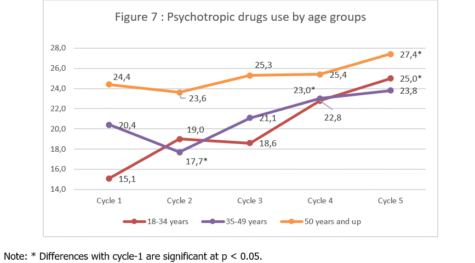
The findings are as follows:
- Overall,
- Psychological distress increased between cycle-1 and cycle-2, but returns to its initial level from cycle-3 ;
- Prevalence of burnout declines in cycle-2, but returns to its initial level by cycle-3;
- The prevalence of psychotropic drug use increases over time, particularly from cycles 4 and 5 onwards.
- For gender and age differences,
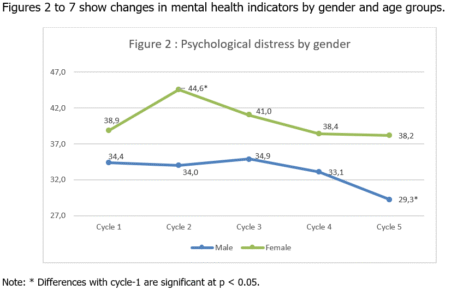
- Psychological distress decreases over time for men, but not for women;
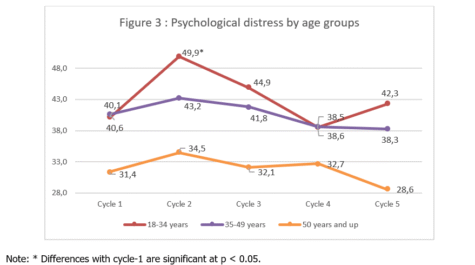
- Distress is relatively stable over time across age groups, but young people (18-34) experienced a significant increase in distress in cycle-2;
- Except for cycle-2, burnout varies little over time for men and women, but there is a downward trend in symptoms for people aged 35-49;
- The use of psychotropic drugs has increased over time for both men and women, and more significantly for people aged 18-34 and those aged 50 and over.
Conclusion
ELOSMET has already documented that mental health problems among the employed people in this sample are significant and vary according to gender and age. At cycle 5, psychological distress affects 34.9% of all respondents, 23.7% report symptoms of burnout and 25.3% take psychotropic medication. The situation for women and younger people continues to give cause for concern.
Overall, the variations in psychological distress and burnout are relatively stable over time, except for the COVID-19 period, which saw an increase in psychological distress among women and young people, but a reduction in burnout. For the whole period (2019-2025), the prevalence of psychological distress would be around 38.1% and 24.0% for burnout. It should be noted, however, that the situation for men in terms of psychological distress seems to be improving over time. Further analysis will be needed to understand what factors have contributed to this decline.
The average prevalence of psychotropic drug use is 21.3%, but the significant increase in this behaviour since Cycle 4 is a cause for concern. It affects both men and women, but seems to have a greater impact on young people and older workers. The results presented here do not make it possible to identify the factors contributing to this increase. Further analysis of the ELOSMET data may shed some light on this question.
References
- McDowell, I. & Newell, C. (1996) Measuring health: a guide to rating scales and questionnaires, 2nd edn. Oxford University Press, New York
- Kristensen, T.S., Borritz, M., Villadsen, E. & Christensen, K.B. (2005) The Copenhagen Burnout Inventory: A new tool for the assessment of burnout, Work & Stress, 19(3), 192-207.
Website: https://www.osmet.umontreal.ca/
About OSMET
The Observatoire sur la santé et le mieux-être au travail (OSMET) is a joint project of the Faculty of Arts and Science, the Institut de recherche en santé publique (now the Centre de recherche en santé publique) and the École de relations industrielles of the Université de Montréal. OSMET is financially supported by three founding partners: TELUS Health, Medavie and Pratt & Whitney Canada.
The OSMET Flash Research collection
- How is the mental health of managers? Decembre 2024. https://www.osmet.umontreal.ca/flash-recherche-comment-ca-va-la-sante-mentale-des-cadres/
- Evolution of mental health indicators in the first four cycles of ELOSMET. October 2024. https://www.osmet.umontreal.ca/flash-recherche-evolution-des-indicateurs-de-sante-mentale-aux-quatre-premiers-cycles-de-lelosmet/
- Mental health in Cycle 4: Contribution of work, non-work and individual factors. July 2024. https://www.osmet.umontreal.ca/flash-recherche-la-sante-mentale-au-cycle-4-contribution-des-facteurs-du-travail-hors-travail-et-individuels/
- Mental health in Cycle 3: Contribution of work, non-work, and individual factor. December 2023. https://www.osmet.umontreal.ca/flash-recherche-la-sante-mentale-au-cycle-3-contribution-des-facteurs-du-travail-hors-travail-et-individuels/
- Evolution of mental health indicators in the first three cycles of ELOSMET study. July 2023. https://www.osmet.umontreal.ca/flash-recherche-levolution-des-indicateurs-de-sante-mentale-dans-les-trois-premiers-cycles-de-lelosmet/
- Prevalence of mental health problems in the workplace during COVID-19: ELOSMET Cycle 2 results. November 2022 https://www.osmet.umontreal.ca/flash-recherche-prevalence-des-problemes-de-sante-mentale-en-milieux-de-travail-pendant-la-covid-19-les-resultats-du-cycle-2-de-lelosmet/
- Mental health in Cycle 2: Contribution of workplace, outside the workplace and individual factors. October 2022. https://www.osmet.umontreal.ca/flash-recherche-la-sante-mentale-au-cycle-2-de-lelosmet/
- The best practices for intervening and reducing mental health problems in the workplace. May 2022. https://www.osmet.umontreal.ca/publications/flash-recherche/flash-recherche-les-meilleures-pratiques-pour-intervenir-et-diminuer-les-problemes-de-sante-mentale-au-travail/
- Psychological distress and burnout: Contribution of work, non-work and individual. October 2021. https://www.osmet.umontreal.ca/flash-recherche-detresse-psychologique-et-epuisement-professionnel-contribution-des-facteurs-du-travail-hors-travail-et-individuels/
- Portrait of the Implementation of Occupational Health and Wellness Management Practices. June 2021. https://www.osmet.umontreal.ca/publications/flash-recherche/flash-recherche-les-pratiques-de-gestion-de-la-sante-et-du-mieux-etre-au-travail/
- The importance of mental health problems in the workplace before and during the COVID-19 crisis: Early results from ELOSMET Cycle-1. January 2021. https://www.osmet.umontreal.ca/publications/flash-recherche/flash-recherche-la-sante-mentale-en-milieux-de-travail-en-temps-de-pandemie/
- Absenteeism and workplace health and wellness management practices. October 2020. https://www.osmet.umontreal.ca/publications/flash-recherche/flash-recherche-labsenteisme-et-les-pratiques-de-gestion-en-sante-et-mieux-etre-au-travail/
- Telework, working conditions and work-family conflicts. June 2020. https://www.osmet.umontreal.ca/flash-recherche-teletravail-conditions-de-travail-et-conflits-travail-famille/
This content has been updated on 2 June 2025 at 18h41.