

FLASH Research : How is the mental health of managers?
Following-up of developments between 2019 and 2023 in ELOSMET.
The Longitudinal Study of the Observatory on Health and Wellness at Work (ELOSMET) is an online survey that has been repeated every year for five years among Canadian workers from various employers of diverse sectors of activity. Between 2019 and 2023, 11,668 people employed in 117 workplaces participated in this study, which addresses several dimensions of health and wellness at work, as well as data on occupation, hierarchy of occupations in the company and, personal characteristics.
This Flash Research focuses more particularly on managers who participated in the first three cycles of ELOSMET. We are used to hearing that the position of manager is difficult, sometimes sandwiched between higher management and employees or being subjected to contradictory demands, an overload of work, difficulty delegating, conflict management, and a difficult work-family balance. Here we present preliminary results concerning the prevalence obtained for the main mental health problems, which are at the heart of OSMET's work: psychological distress, burnout and psychotropic drugs use. We also examine whether differences exist based on gender, age and hierarchical level of managers (senior managers, middle managers and first-level managers). Finally, we evaluate whether managers differ from non-managers in terms of the prevalence of these mental health problems.
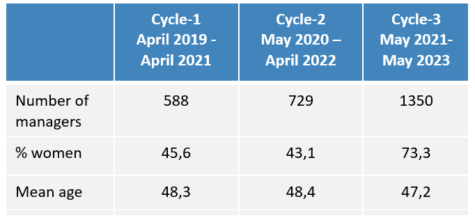
The following table presents the main socio-demographic characteristics of the sample of managers on which this FLASH research focuses.
The following questionnaires were used:
- Psychological distress: Minor psychiatric disorders (depressive symptoms, anxiety, irritability, cognitive problems) not specific to a particular illness. Score of 4 and above on the General Health Questionnaire (GHQ-12).1
- Professional burnout: Fatigue, physical and psychological exhaustion perceived by the person as being linked to their work. Score of 50 and above (moderate symptoms and above) on the Copenhagen Burnout Inventory (CBI-7).2
- Psychotropic drugs use: Consumption during the last month of at least one medication such as tranquilizers (e.g.: diazepam, Valium), antidepressants (e.g.: fluoxetine, Prozac), opiates (e.g.: codeine, Ratio-Lenoltec #3), or sleeping pills (e.g. zopiclone, Imovane)
The results are presented in the graphs below:
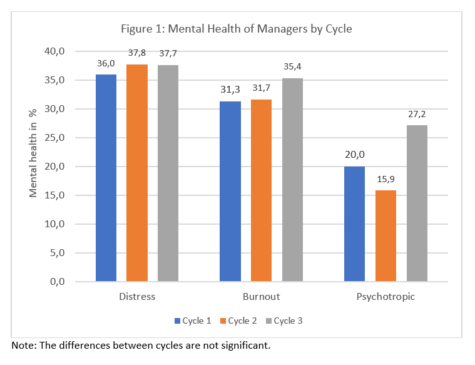
Figure 1 shows the general evolution of the three mental health indicators.
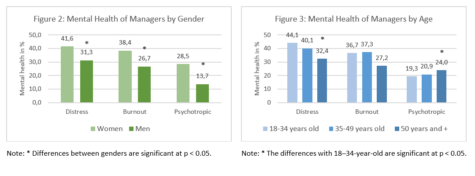
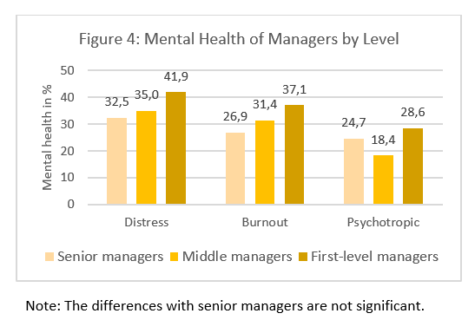
Figures 2 to 4 present the differences in the three mental health indicators according to gender, age and manager level.
Figures 5 to 10 present the evolution of mental health indicators according to gender, age and manager level.
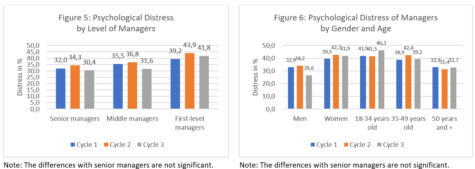
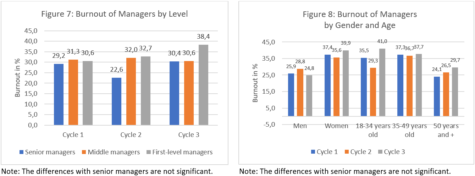
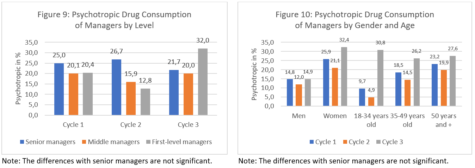
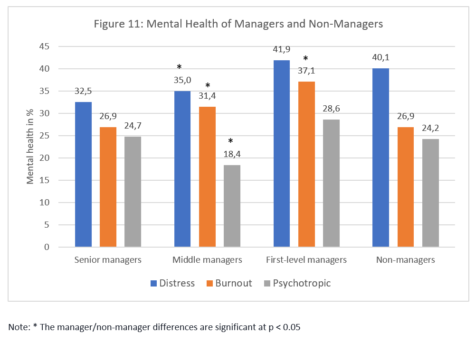
Figure 11 presents the differences in prevalence between managers and non-managers for the three mental health indicators.
The findings are as follows:
- Globally,
- Psychological distress and burnout affect between 31.1%-37.8% of managers and 16.0%-27.2% use psychotropic medications;
- The differences in prevalence between cycles are not significant;
- Burnout is more common among middle and first-level managers than among non-managers.
- For gender differences,
- Women report more symptoms of psychological distress and burnout, and they use more psychotropic medications than men;
- The differences between cycles between genders are not significant.
- For age differences,
- Managers aged 50 and over are less affected by psychological distress and use less psychotropic medication than managers aged 18-34;
- The differences between cycles according to age groups are not significant.
- For managers’ level differences,
- The differences between managers’ levels are not significant.
- The differences between cycles according to managers’ levels are not significant.
Conclusion
Mental health problems among managers are important and women are more seriously affected than men are. In addition, older managers tend to be less affected by problems of psychological distress and consumption of psychotropic medications. We observe some signs of increase over time but, overall, these issues remain relatively steady between 2019-2023. The extent of psychological distress is similar to that of non-managers, but burnout is more common among managers.
Despite organizations devoting significant efforts to develop practices to promote employee health and well-being at work, managers are often forgotten. Even though they are responsible for managing these practices, few of them adapt more specifically to the needs of the people occupying their management functions. The manager is often perceived as the warrior, the resistance fighter, always present but, as the results presented here show, possibly in a state of suffering that goes unnoticed, a state that needs more attention.
References
- McDowell, I. & Newell, C. (1996) Measuring health: a guide to rating scales and questionnaires, 2nd edn. Oxford University Press, New York.
- Kristensen, T.S., Borritz, M., Villadsen, E. & Christensen, K.B. (2005) The Copenhagen Burnout Inventory: A new tool for the assessment of burnout, Work & Stress, 19(3), 192-207.
Website: www.osmet.umontreal.ca/en/
About OSMET
The Observatory on Health and Well-being at Work (OSMET) was born from a collaboration with the Faculty of Arts and Sciences, the Public Health Research Institute (now the Public Health Research Center) and the School of Industrial Relations of the University of Montreal. OSMET benefits from the financial support of three founding partners: TELUS health, Medavie and Pratt & Whitney Canada.
The OSMET FLASH Research collection
- Telework, working conditions and work-family conflicts. June 2020. https://www.osmet.umontreal.ca/publications/flash-recherche/flash-recherche-teletravail-conditions-de-travail-et-conflits-travail-famille/
- Absenteeism and workplace health and wellness management practices. October 2020. https://www.osmet.umontreal.ca/publications/flash-recherche/flash-recherche-labsenteisme-et-les-pratiques-de-gestion-en-sante-et-mieux-etre-au-travail/
- Mental health in the workplace during a pandemic: Early results from ELOSMET Cycle-1. January 2021. https://www.osmet.umontreal.ca/publications/flash-recherche/flash-recherche-la-sante-mentale-en-milieux-de-travail-en-temps-de-pandemie/
- Portrait of the implementation of occupational health and wellness management practices. June 2021. https://www.osmet.umontreal.ca/publications/flash-recherche/flash-recherche-les-pratiques-de-gestion-de-la-sante-et-du-mieux-etre-au-travail/
- Psychological distress and burnout: Contribution of work, non-work, and individual factors. October 2021. https://www.osmet.umontreal.ca/flash-recherche-detresse-psychologique-et-epuisement-professionnel-contribution-des-facteurs-du-travail-hors-travail-et-individuels/
- The best practices for intervening and reducing mental health problems in the workplace. May 2022. https://www.osmet.umontreal.ca/publications/flash-recherche/flash-recherche-les-meilleures-pratiques-pour-intervenir-et-diminuer-les-problemes-de-sante-mentale-au-travail/
- Mental Health in Cycle 2 of ELOSMET study. October 2022. https://www.osmet.umontreal.ca/flash-recherche-la-sante-mentale-au-cycle-2-de-lelosmet/
- Prevalence of mental health problems in the workplace during COVID-19: ELOSMET Cycle 2 results. November 2022. https://www.osmet.umontreal.ca/flash-recherche-prevalence-des-problemes-de-sante-mentale-en-milieux-de-travail-pendant-la-covid-19-les-resultats-du-cycle-2-de-lelosmet/
- Evolution of mental health indicators in the first three cycles of ELOSMET study. July 2023. https://www.osmet.umontreal.ca/flash-recherche-levolution-des-indicateurs-de-sante-mentale-dans-les-trois-premiers-cycles-de-lelosmet/
- Mental health in Cycle 3: Contribution of work, non-work, and individual factors. December, 2023. https://www.osmet.umontreal.ca/flash-recherche-la-sante-mentale-au-cycle-3-contribution-des-facteurs-du-travail-hors-travail-et-individuels/
- Mental health in Cycle 4: Contribution of work, non-work and individual factors. July 2024. https://osmet.openum.ca/en/flash-recherche-la-sante-mentale-au-cycle-4-contribution-des-facteurs-du-travail-hors-travail-et-individuels/
- Evolution of mental health indicators in the first four cycles of ELOSMET. October 2024. https://www.osmet.umontreal.ca/en/flash-recherche-evolution-des-indicateurs-de-sante-mentale-aux-quatre-premiers-cycles-de-lelosmet/
This content has been updated on 18 December 2024 at 10h50.